
Understanding Different Form Strategies
This section discusses two primary approaches for managing user input within web applications: one that relies on the framework’s reactive capabilities to handle form state and validation dynamically, and another that employs a more traditional, model-driven method to bind form controls directly to data models. Each approach offers distinct advantages in terms of responsiveness, scalability, and ease of maintenance, and choosing between them depends on the specific requirements and complexity of the project. Proper understanding and application of these strategies are crucial for building efficient, reliable, and user-friendly interfaces.
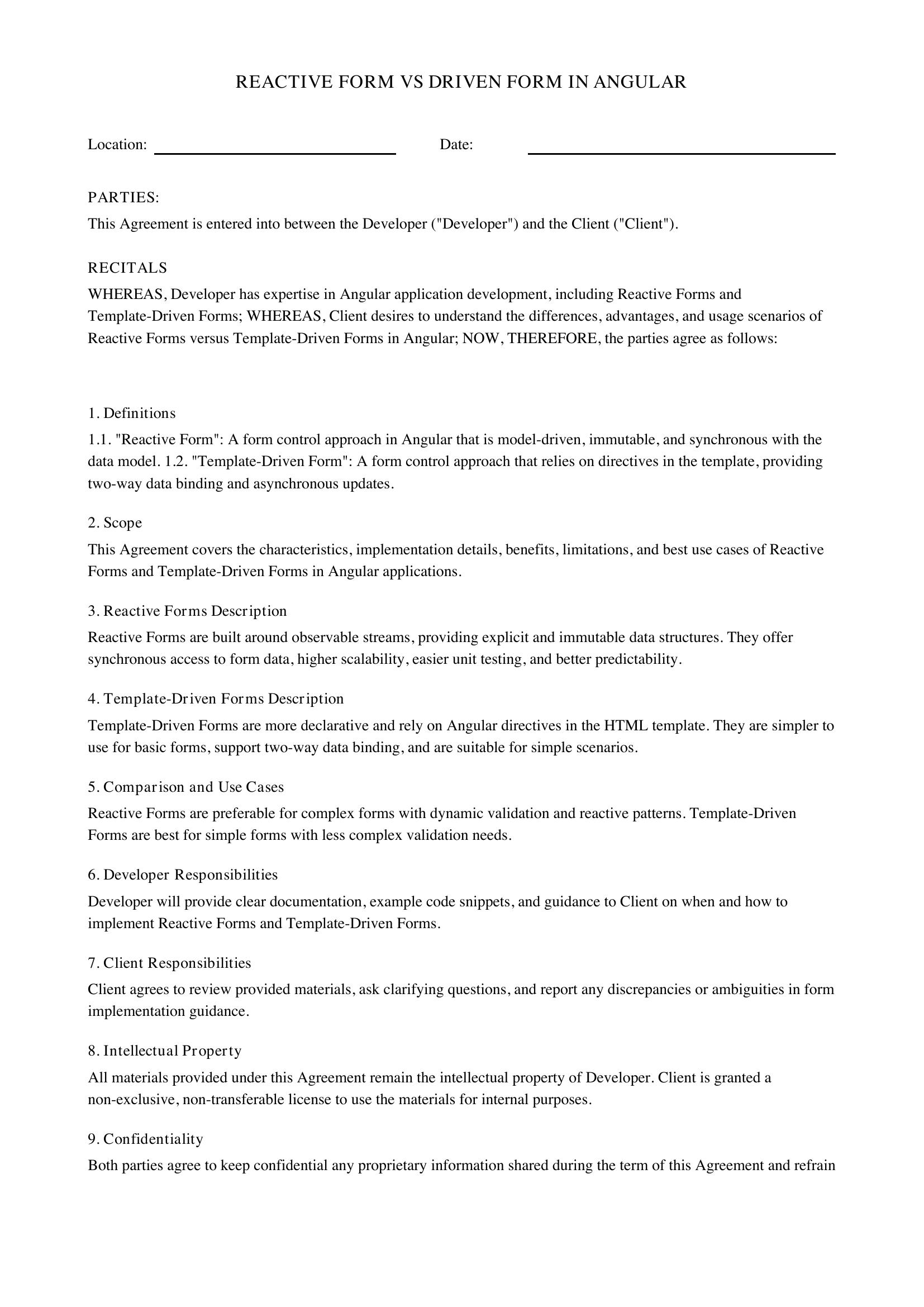
Please note: This is a provisional template for a comparison between Reactive and Driven Forms in the US context. Actual implementations may vary based on project requirements and legal considerations.
Reactive Form vs Driven Form in the US — Sample Overview
Participants:
Developer: Tech Solutions Inc.
Address: 123 Innovation Drive, Silicon Valley, CA 95002
Client: Acme Corp.
Address: 456 Business Park, New York, NY 10001
Form Types:
This document compares Reactive Forms and Driven Forms within the US development environment, highlighting their characteristics, advantages, and typical use cases.
Key Features:
- Reactive Forms: Offer programmatic control, ideal for complex validations, dynamic form creation, and unit testing.
- Driven Forms: Emphasize template-driven approach, suitable for simpler forms with less programmatic logic.
Developer Responsibilities:
The developer agrees to implement form handling according to best practices, ensuring accessibility, validation, and responsiveness in line with US standards.
Legal & Compliance:
This comparison adheres to applicable US development guidelines and best practices for web accessibility and user data handling.
Additional Notes:
- Both form types have their advantages; selection depends on project complexity and developer expertise.
- This template is meant for informational purposes and should be adapted to specific project needs.
New York, ______________________
Alex Johnson (Developer)
Emily Davis (Client)